Solutions Design & Optimise
Mission-optimised. Digitally perfected.
No drones are alike, because no missions are the same.
FF Twin lets you simulate and optimise your entire UAV, aerodynamics, propulsion and energy as one system before the first physical part is built.
Accelerate iterations from weeks to seconds and eliminate unviable prototypes.
Achieve maximum flight time, stable flight, and a design tailored to your specific mission.
How it works
Physical iterations cost weeks and can be replaced by digital iterations taking only seconds to compute. A connected model validates every component digitally — and optimises it for your mission.
- Purpose
- Build & test
- Analyse
- Redesign
Weeks per loop. Every answer costs a prototype.
- 01Purpose
- 02Model
- 03Simulate
- 04Optimise
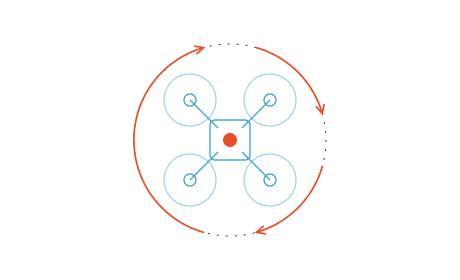
All components validated together — optimised for your mission.
One UAV. One system.
Change one parameter, see the effect on all aspects of the complete vehicle.
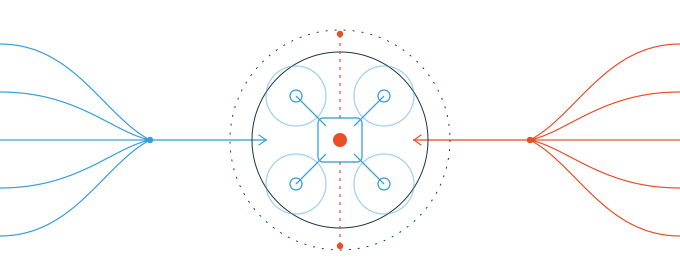
FF Twin
Model · Simulator · Analyser · Optimiser
- Purpose
- Payload
- Range
- Speed
- Environment
- Operational requirements
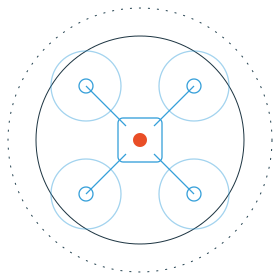
FF Twin
Model · Simulator · Analyser · Optimiser
- Vehicle design
- Component selection
- Energy use
- Flight performance
- Control strategy
- Mission profile
The model treats geometry, components, airflow, power and control as connected parts of the same UAV.
Same platform. Four different drones.
Choose a mission and see how the optimal architecture changes — wing or rotors, size, propulsion and energy source all follow from what the drone has to do.
Most drones are designed first and optimised afterwards. With FF Twin, optimisation starts before the first design decision is made and continues throughout the lifecycle.
Each requirement is linked to its consequence for the design, so you can see what it costs in weight, energy and flight time. Propellers, motors, battery and airframe are tuned together as one system, not chosen as good parts on their own. Each iteration takes seconds rather than a physical build-and-test cycle, which saves both time and money.
Large wing, VTOL lift rotors
Optimised for long range and heavy payload. A wing carries the load in cruise; lift rotors used for take-off and landing.
Optimised for- Range
- Payload
- Cruise efficiency
Illustrative configurations — real configurations are calculated for each mission.
What we optimise
Aerodynamics
All surfaces affecting airflow (wings, fuselage, anything visible from the outside).
Propulsion
Type and size. For propellers: geometry and size. For rocket motors: solid or liquid fuel, fuel type, etc. For engines: electric, petrol, gas, or turbine.
Placement of the propulsion system relative to the rest of the drone.
Energy storage
Battery, petrol, propane, or gas. Includes size and placement, as well as whether capacity is sufficient for the required range plus a safety margin.
Structure
Strength and material thickness, static engineering calculations.
One model throughout the lifecycle.
The UAV model is reused instead of rebuilt at every stage.
- 01
Purpose
Define goals, use and requirements
- 02
Design
Geometry, components and performance
- 03
Produce
Suppliers, components and configuration
- 04
Train
Simulation and pilot training
- 05
Operate
Mission planning, control and automation
- 06
Improve
Digital twin, maintenance and redesign
See the challenge and the FF Twin solution
The FF Twin Component Explorer lets you explore the role of each component in your UAV design. Click any component to understand the challenge it presents and how FF Twin addresses it.
- Multirotor
- VTOL / Fixed Wing
- Rocket
Get more out of the drone you already have.
See where your current drone loses energy, and which changes pay off — without a redesign.
- Upgrades limited to bolt-on parts — propellers, motors, batteries
- Cost-benefit analysis, so you only change what pays off
Find out what your drone can do better.
FF Twin connects a fragmented UAV development process.
- Separate tools
- Separate experts
- Separate models
- Physical iteration
- One-size-fits-all designs
- One UAV model
- One connected workflow
- Digital iteration
- Mission-specific optimisation
- Reusable throughout the lifecycle
A UAV engine for developing, adapting and operating unmanned systems.
Built on physics-based models and peer-reviewed multirotor research.